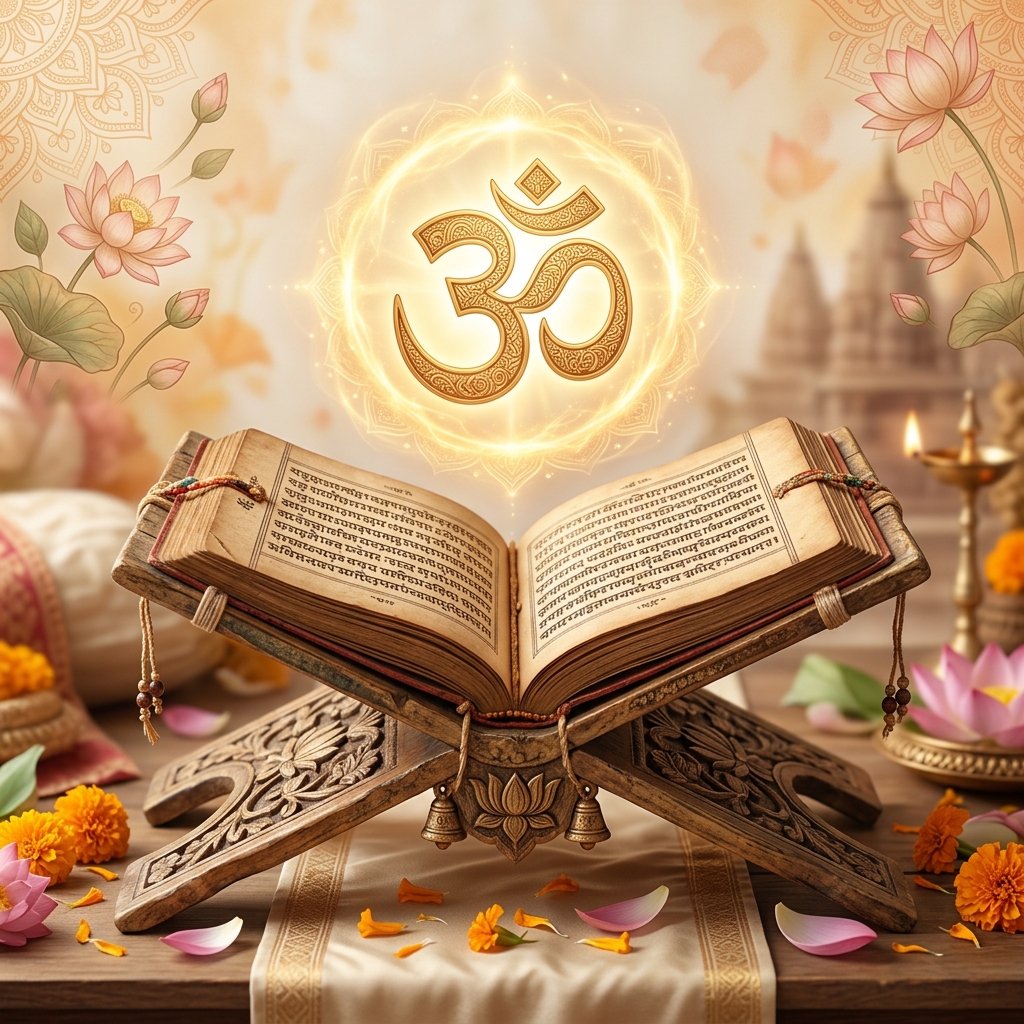
Summary of the Four Vedas
The Vedas are the foundational scriptures of Hindu Dharma. Sages preserved their deepest spiritual insights as sacred mantras for future generations. Each Veda illuminates a distinct path of life and worship.
- Rigveda — Praise, hymns, and divine knowledge
- Yajurveda — Ritual conduct and sacred action
- Samaveda — Devotion, melody, and worship
- Atharvaveda — Protection, healing, and daily life
The Vedas (/ˈveɪdəz/[4] or /ˈviːdəz/;[5] Sanskrit: वेदः, romanized: Vēdaḥ, lit. 'knowledge'), sometimes collectively called the Veda, are a large body of religious texts originating in ancient India. Composed in Vedic Sanskrit, the texts constitute the oldest layer of Sanskrit literature and the oldest scriptures of Hinduism.[6][7][8]
There are four Vedas: the Rigveda, the Yajurveda, the Samaveda and the Atharvaveda.[9][10] Each Veda has four subdivisions – the Samhitas (mantras and benedictions), the Brahmanas (commentaries on and explanation of rituals, ceremonies and sacrifices – Yajñas), the Aranyakas (text on rituals, ceremonies, sacrifices and symbolic-sacrifices), and the Upanishads (texts discussing meditation, philosophy and spiritual knowledge).[9][11][12] Some scholars add a fifth category – the Upāsanās (worship).[13][14] The texts of the Upanishads discuss ideas akin to the heterodox śramana traditions.[15]
Vedas are śruti ("what is heard"),[16] distinguishing them from other religious texts, which are called smr̥ti ("what is remembered"). Hindus consider the Vedas to be apauruṣeya, which means "not of a man, superhuman"[17] and "impersonal, authorless",[18][19][20] revelations of sacred sounds and texts heard by ancient sages after intense meditation.[21][22]
The Vedas have been orally transmitted since the 2nd millennium BCE with the help of elaborate mnemonic techniques.[23][24][25] The mantras—the oldest part of the Vedas—are recited in the modern age for their phonology rather than their semantics, and are regarded as "primordial rhythms of creation", preceding the forms to which they refer.[26] By reciting them the cosmos is regenerated, "by enlivening and nourishing the forms of creation at their base."[26]
The words of the Vedas are our guiding light